
 Like Us

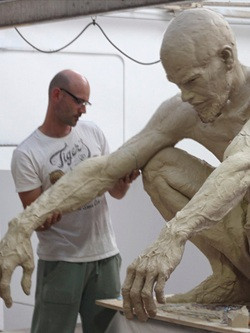
James Stewart’s early practice in realism centered on a fascination with the shared gestures, physicality, and humanity that connect cultures across the world. Through the human figure, he sought to reveal something universal—an emotional language capable of transcending geography and circumstance. His work became a study of the ways the body communicates, and of the quiet gestures through which human experience is recognized across cultures.
With Drift, Stewart distills decades of observation and study into abstraction. Each work becomes a vessel for transition: a suspended moment in which stillness gives way to momentum, intention becomes action, and a single breath moves toward release. Rather than depicting a specific place or body, Drift explores the sensation of becoming—the quiet instant when commitment transforms into movement and the physical approaches something almost ecstatic.
This sensitivity to form and movement was developed through decades of professional sculptural work in the film industry. Trained as a sculptor for hire, Stewart worked behind the scenes to translate imagined characters and creatures into physical form, bringing technical precision and an intuitive understanding of anatomy, gesture, scale, and surface to each project. His work has contributed to characters recognizable from the silver screen, including Aslan in The Chronicles of Narnia: The Lion, the Witch and the Wardrobe, the donkey dragons from Shrek, and the aliens of District 9. Alongside his independent practice, he continues to accept commissions and collaborate with artists, helping transform their visions into tangible sculptural works.
Yet Stewart’s artistic vocabulary has been shaped as much by his experience of the world as by his years in the studio. Having traveled extensively across the globe, he has made a point of seeking out local art, artists, cultural traditions, and museums wherever his journeys have taken him. These encounters have provided a continual source of observation and discovery, expanding his understanding of how different cultures interpret the body, movement, emotion, and place.
